


Sewer Cleanout Installation in Sacramento County
Without a cleanout, every future sewer problem is harder, slower, and more expensive to reach. We install a permanent access point on your lateral, permitted and inspected under our own license.



What Happens When There Is No Cleanout
A sewer lateral runs from your house to the public main, usually buried three to six feet down. A cleanout is the capped pipe that gives direct access to it from the surface. Plenty of older homes never got one.
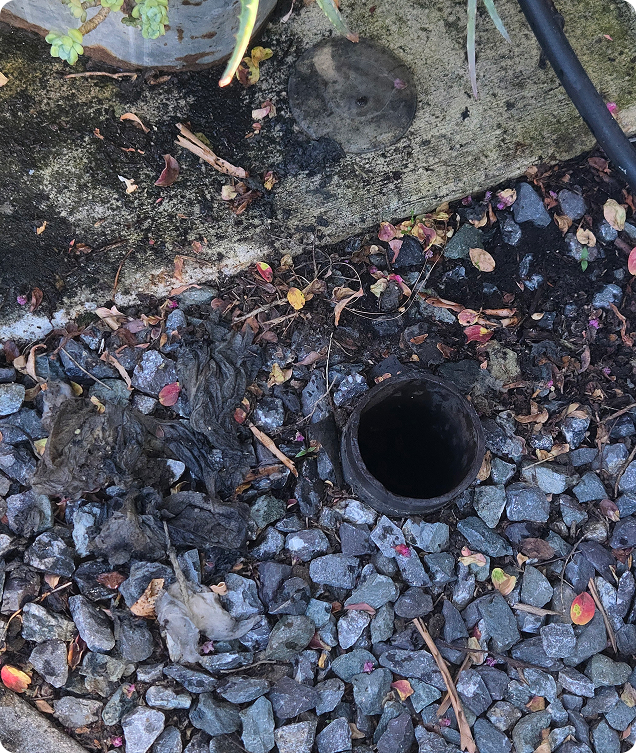
When there is no cleanout and the line backs up, the plumber has to reach the lateral some other way. That usually means going through a roof vent, which is a long and awkward path, or pulling a toilet off its flange to work through the opening underneath. Both add labor to every single visit. Both limit which equipment can actually be used, because a cable fed down a vent cannot apply the same force as one fed straight into the line.
The cost of that shows up every time, not once. A household that calls for a backup every couple of years pays the access surcharge every couple of years.
A Cleanout Is a Simple Thing in an Exact Place
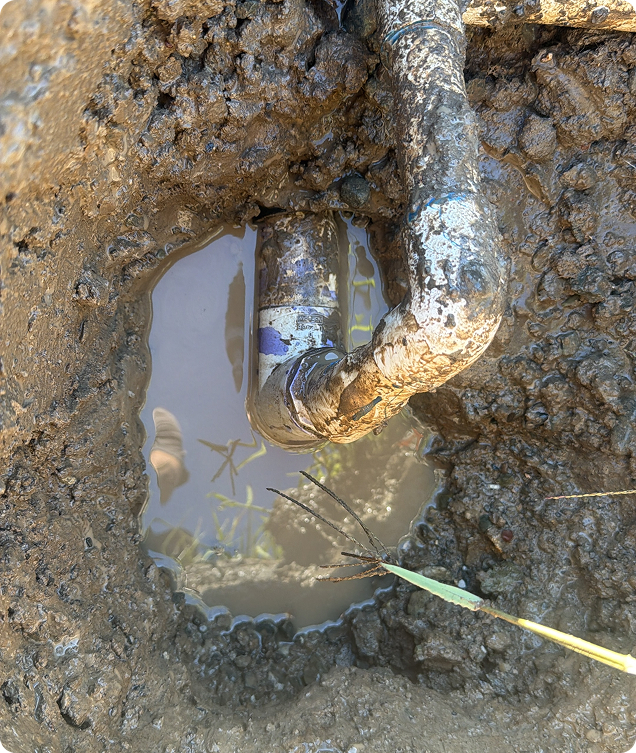
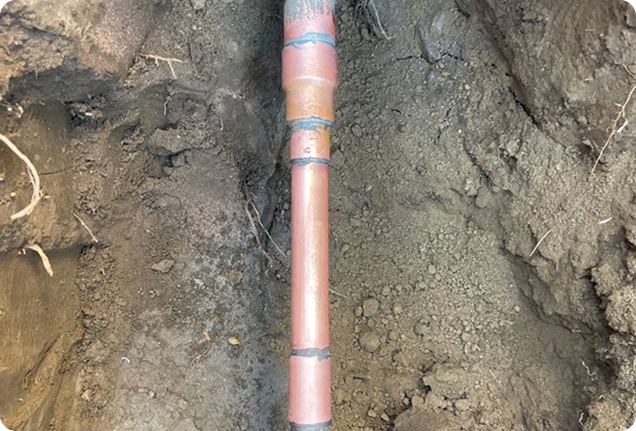
The fitting itself is not complicated. A wye is cut into the lateral, a riser carries it up to ground level, and a threaded cap closes it off. The cap sits flush with the surface, usually inside a small box with a removable lid so a mower passes over it without catching.
Our standard installation is a two-way cleanout at the foundation, where the lateral leaves the house. The two-way fitting lets a cable or a camera run toward the street or back toward the house from the same opening, which is why one fitting in that position covers almost every future call.
Placement is the part that matters, and in this region it decides more than convenience. Under the Sacramento Area Sewer District ordinance, the dividing line between the portion of the lateral you are responsible for and the portion the District is responsible for falls at the District cleanout. Where no cleanout exists, that dividing line moves out to the edge of the public right-of-way or easement instead. The cleanout is what fixes the boundary of your liability rather than leaving it stretched toward the street.
That is also why position is specified rather than left to the installer. A fitting set in the wrong place still gives access, but it does not move the boundary, and the boundary is the expensive half of the benefit.
From Locating to Sign-Off
One thing to know in advance. We backfill and compact, and we leave the site clean, but we do not re-seed lawn or pour concrete. If we had to cut through a driveway or a patio to reach the line, the surface restoration is a separate trade and we will tell you that before we start.
We find the lateral
We pull the permit
We open the ground and cut in the wye
We test and close up
Homes That Should Not Wait
- Houses built before the 1970s, when cleanouts were not standard on every lateral
- Any home where a plumber has had to pull a toilet to clear the line
- Properties with mature trees between the house and the street
- Homes that have backed up more than once in the same decade
- Anyone about to schedule a camera inspection, since a cleanout gives the camera a clean entry
- Sellers preparing for a sale, where a documented, accessible lateral removes a negotiating point
Spreading the Cost
Through Wisetack, you can apply for financing in about a minute from your phone and see real rates before you commit. Checking your rate has no impact on your credit score.
Financing is an option, not a condition. If you would rather pay outright, nothing about the job changes.
Why Homeowners Call Us Back

In-House Licensed Technicians

Upfront Flat-Rate Pricing

Expert Permit Management

1-Year Labor Warranty


Sewer Cleanout Questions We Hear Most
- Will a cleanout stop my drains from backing up?
No, it will not. A cleanout does not fix a damaged or blocked line. What it does is give direct access to that line, so the blockage can be cleared faster, with better equipment, and without taking a toilet off the floor. If the lateral itself is the problem, the cleanout is what lets us see it and reach it.
- Does installing a cleanout require a permit?
Yes, it does. Cutting into a sewer lateral is inspected work. We file the permit under our license, meet the inspector, and hand you the signed paperwork when the job closes.
- My plumber went in through the roof. Does that mean my house has no cleanout?
Not necessarily. Plenty of homes have one that has been paved over, buried under a flower bed, or covered by a deck added later. We locate the lateral before quoting an installation, and if an existing cleanout turns up, we tell you and you save the cost of a new one.
- How visible will it be in the yard?
Barely. The cap sits flush with the surface inside a small box with a lid, roughly the size of a sprinkler valve cover. It does not stand above the grass and it does not interfere with mowing.
- Can you install a cleanout without digging up the whole yard?
Yes. The work happens at one point on the line, not along its length. Because we trace the lateral first, the excavation is sized to the fitting rather than to a search.
- Do you install cleanouts in the South Bay as well?
Yes, we do. Our San Jose team installs cleanouts across the South Bay on standard scheduling. The local rules are different there, since San Jose runs its own lateral and wye cleanout policy, and our San Jose page explains how that works. Reach that team at (669) 280-7227.
Tired of Paying Extra to Reach Your Sewer Line?
We serve Sacramento County and the surrounding area. Permit filing and inspection are handled under our license as part of the job.